
An independent software laboratory where puzzle-solving needs become working tools, experiments, and reusable features.
What Is QuizLabs?
QuizLabs is the umbrella identity for my independent software experiments and products. It gives me a place to explore ideas, develop specialized tools, test new workflows, and carry projects from initial concept through implementation and continued refinement.
These projects complement my professional engineering work by giving me full responsibility for product definition, technical decisions, usability, testing, and deployment.

The Algebrator
A Java/Vaadin algebra and puzzle-solving application that combines conventional calculation with specialized tools I built in response to real problem-solving needs.
The Algebrator demonstrates independent software design, domain modeling, iterative feature development, and AI-assisted engineering — growing through repeated use and accumulated requirements rather than from a fixed spec.
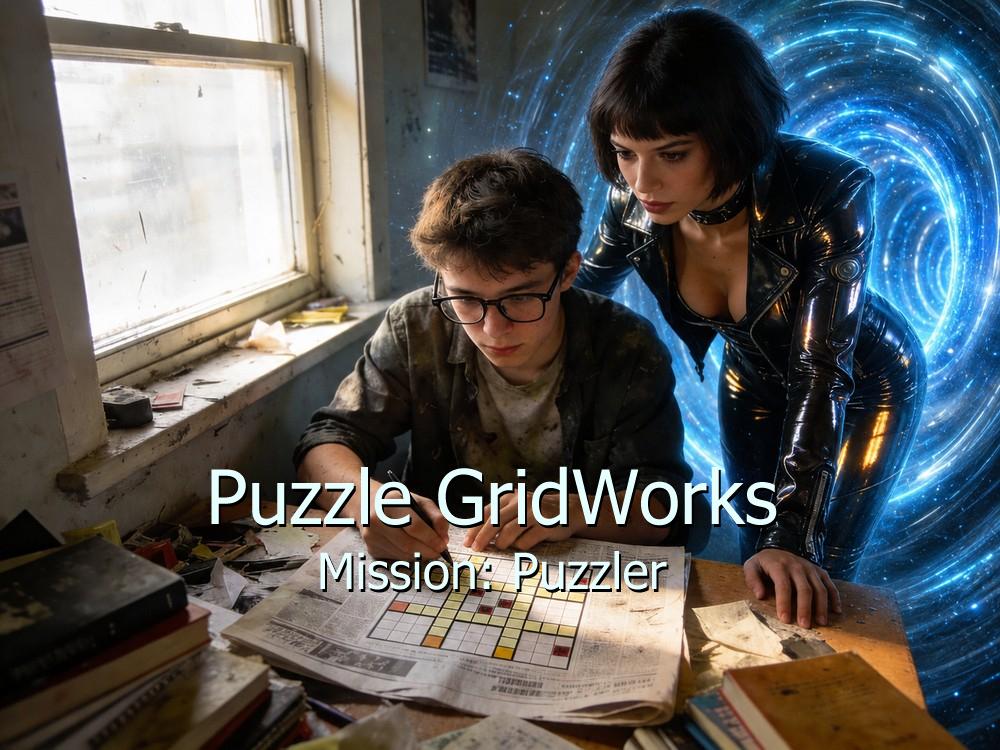
Puzzle GridWorks
A visual workspace for importing puzzle images, adding interactive overlays and annotations, and creating clean demonstrations of puzzle-solving workflows.
PGW demonstrates UI and workflow design, iterative product development, and my ability to respond to real-world usability problems while maintaining and extending a growing application.

Silent E
An AI-assisted visual storytelling project built around Tom Lehrer's public-domain song "Silent E," combining music, image generation, visual direction, editing, humor, and narrative continuity.
My work on Silent E demonstrates visual concept development, generative-AI direction, iterative prompting and refinement, editing, and multimedia production — skills that reinforce requirements analysis and AI-output evaluation across all QuizLabs work.

A Development Laboratory
The projects also provide a controlled environment in which I can experiment with AI-assisted software development techniques, specification writing, testing strategies, UI workflows, and iterative feature design.
Lessons learned through QuizLabs frequently inform professional development practices, particularly around:
- Keeping AI-assisted work narrowly scoped
- Providing strong context before implementation
- Separating analysis from coding
- Testing generated changes rather than accepting them at face value
- Recognizing when technically correct behavior creates a poor user workflow
- Using AI to expand capability without surrendering engineering judgment